
“Another day, another heap of endless chores and things to do… What if life could be an adventure? An adventure where a need turns into a NeedBar and each task becomes a Quest?”
– A thought I had a couple of months ago
A Letter for Adventurers of the Mundane
Welcome, Adventure Seeker or Escapist of Mundanity!
I’ve been working on a way to make daily tasks, chores, routines and self care feel like an adventure by turning them into a videogame-like QuestScroll.
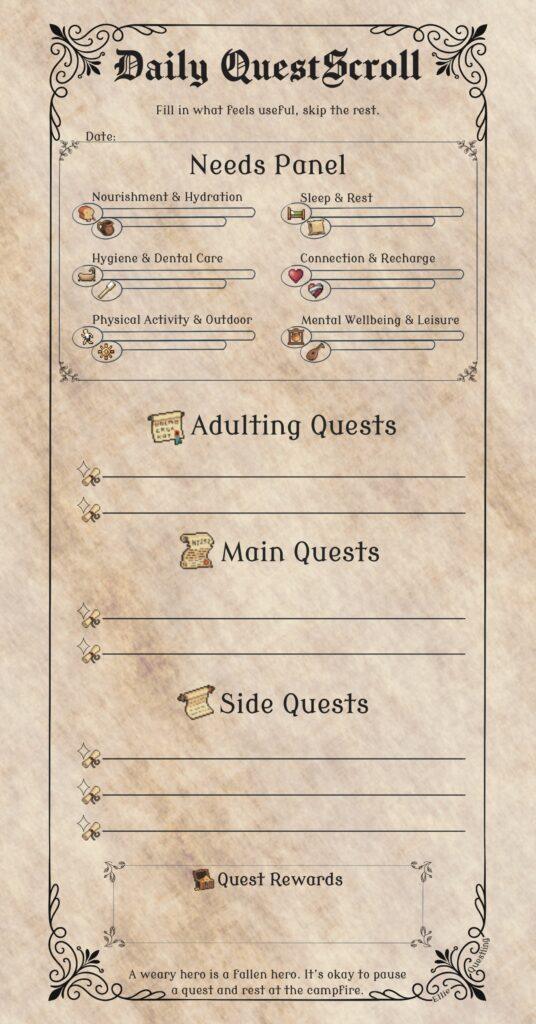
After some trial and error and hours of tinkering around in Procreate, I managed to come up with this Daily QuestScroll Prototype.
I am leaving this letter to be found by anyone looking for a Quest in the everyday, tucked away in this little pocket dimension of the internet.
Alongside it, you’ll find a downloadable version of the QuestScroll Prototype, as well as some guidelines on how to use it.
May each day feel like an adventure, sparking joy in the mundane.
With chaotic excitement and a mind full of Quests,
Elie Questling
Post Index
- Introduction – Use it Your Way
- The Needs Panel Introduction
- Four Approaches to NeedBars
- The Quest Categories
- The Quest Rewards
- Download
- Printing Instructions
Use it Your Way
“In a world with shoulds and shouldn’ts, this QuestScroll is yours alone. It’s yours to use in a way that works for you.”
– A thought about using the Daily QuestScroll Prototype
There are different ways to use this Daily QuestScroll and there isn’t one right way to use it. This page is meant as a starting point to guide you when you’re not sure where to begin.
I left a small note at the top of the Daily QuestScroll to encourage you to Use it Your Way. “Fill in what feels useful, skip the rest.”
The following “How Tos” are meant as examples instead of rules. You don’t need to use all of them, or even any of them. They’re tools to help you use this Daily QuestScroll and tailor it to your own mind.
The Needs Panel Introduction
A weary hero is a fallen hero, it’s okay to pause a Quest and rest at the campfire.
– A note at the bottom of the QuestScroll for self-compassion
The Needs Panel is a way to make your needs more visible, making it easier to notice what you might need so you can take care of it.
I sometimes feel like self care and taking care of your own needs get viewed by society as an afterthought instead of a necessity.
This is why I put the Needs Panel above the Quests of that day.
To me, productivity is something that can happen as a result of taking care of myself. Putting the Needs Panel at the top of the page is my way of saying that self care is just as valid as more traditional ways of being productive.
Here is a list of the 6 pairs of needs (NeedPairings) I picked and a brief description:
1. Nourishment & Hydration
This NeedPairing is about feeding yourself and keeping yourself hydrated.
2. Sleep & Rest
This NeedPairing is about allowing your body and mind to get enough sleep throughout the night and enough rest throughout the day.
3. Hygiene & Dental Care
This NeedPairing is for Basic Hygiene and taking care of your teeth.
4. Connection & Recharge
This NeedPairing is about connecting with other people and finding a sense of belonging without burning through your social battery.
5. Physical Activity & Outdoor
This NeedPairing is about getting enough physical activity by moving throughout the day and getting enough fresh air and sunlight.
Mental Wellbeing & Leisure
This NeedPairing is about taking care of your mental health and doing things you enjoy.
If you feel like the use of NeedBars comes intuitively to you, feel free to skip directly to the Quest Categories, the Quest Rewards or the Download. If you want to know more about how I approach using the NeedBars, you can continue below.
Four Approaches to NeedBars
While using the prototype myself, I noticed that I approach the NeedBars in the Needs Panel in four different ways. I usually end up mixing these different ways of approaching them together, even when using one single NeedBar. It all depends on the need and how I currently fill in that need.
1. Status NeedBar (Check-in & Effects)
“Using a Status NeedBar is a way to notice how a need is affecting you, so you can respond to it more intentionally.”
– The idea behind a Status NeedBar
I approach a NeedBar as a Status NeedBar when I want to become more aware of how it affects me and want to take a moment to adjust my actions. The Sleep NeedBar is the main NeedBar I’m using that way.
I sometimes have trouble sleeping and deal with an irregular sleeping schedule. This is why I like to use the Sleep NeedBar to mark how many hours I’ve slept the night before. If I only slept three hours, I use it as a status check-in to remind myself to head to bed earlier or allow myself to take it easy that day.
As a self-proclaimed ambivert, I use the Connection & Recharge NeedBars as Status NeedBars as well.
When my Connection NeedBar is maxed out, I know that I’ll have to consciously step away from social interactions. Muting notifications or deliberately choosing to answer after recharging my social battery prevents me from dealing with a social burnout later.
The opposite is true for me as well. When I see that my Recharge NeedBar is completely filled that day, I see it as a sign that I’ve recharged enough to connect with other people again.
Another NeedBar that comes to mind is the Nourishment NeedBar. I’m someone who can get hangry when I am hungry so I know that I need to count to ten and watch my words if I have to interact with other people before I can fill up my Nourishment NeedBar.
I like to use this shorthand to remember the Status NeedBar in the moment:
Status NeedBar = Effect/Impact -> Adjusted Approach
(Example: Three hours of sleep = Sleep debt collector eying me -> Head to bed earlier)
You definitely don’t have to use this shorthand if it doesn’t help you.
2. Tracker NeedBar (Routines & Specific Tracking)
“No matter if you divide in advance or just estimate while filling in your NeedBar, a Tracking NeedBar can help you keep track of routines and other things.”
– The purpose of a Tracker NeedBar
I use a NeedBar as a tracker when I already have a set routine for a need or want to track something specific. One of my set routines that I’m tracking with a Tracker NeedBar is my Dental Care Routine.
My Dental Care routine consists of four actions and my Dental Care NeedBar is divided into the same amount of sections:
- Morning teeth brushing
- Evening teeth brushing
- Flossing
- Mouth Wash
Each section of the Tracker NeedBar works as a Checkbox for the actions in my routine.
I use the Sleep NeedBar and the Hydration NeedBar to track specific things.
My Sleep NeedBar is divided in eight with each section representing one hour since I’m aiming for eight hours of sleep each night.
My Hydration NeedBar is divided in six since I mainly use a water bottle of 400ml so a full Hydration NeedBar is 2.4L of water.
I use the following list to remember some possible ways to use a Tracking NeedBar:
Amount of Sections in Tracker NeedBar =
1. Amount of Routine Actions
(Example: 3 meals a day + 1 snack moment = 4 NeedBar Sections)
2. Total Amount in Units / Preferred way to Measure
(Example 1: 2.4L of water / water bottle of 400 ml = 6 NeedBar Sections)
(Example 2: 2 hours of leisure time a day / Blocks of 30 minutes = 4 NeedBar Sections)
3. Total Amount a day per Unit or Action
(Example 1: 8 hours of sleep a day = 8 NeedBar Sections)
(Example 2: 3 random dance breaks a day = 3 NeedBar Sections)
These are just some examples of how I currently use my own Tracker NeedBars. If you want to track other things or use them another way, don’t hesitate to do so!
3. Celebration NeedBar (Reward/Acknowledgement)
A Celebration NeedBar treats each action that fills up this bar as a celebration of effort, no matter how big or small.
– The idea behind a Celebration NeedBar
It’s there to allow yourself to acknowledge what you did, instead of putting yourself down by focussing on the things you could have done.
I believe that every small thing counts and builds up into something bigger. This is why I like to use Celebration NeedBars as a way to not only acknowledge big completed actions, but effort and small actions as well.
I like to approach the Physical Activity & Outdoor NeedBars as Celebration NeedBars.
Instead of only allowing myself to only fill in the Physical Activity NeedBar after working out, I also see other forms of movement as a valid way to fill this NeedBar.
Walking as I do my errands, dancing around the house, taking the stairs instead of the elevator,… All of these actions count towards filling up the Physical Activity NeedBar.
The same goes for the Outdoor NeedBar. By approaching it as a Celebration NeedBar, I don’t have to see filling in my Outdoor NeedBar as one big action or event.
Things like just catching a couple of minutes of fresh air, taking a moment to enjoy the sun or even opening a window all counts up and shows effort.
When I do end up working out or spending a long amount of time outside, I max out the NeedBar to appreciate the effort it took.
A maxed out bar tells me that the need is taken care of for that day. To me, it feels like giving myself permission to stop moving the goalpost and just celebrate what I did.
So in short, I like using the Celebration NeedBar for mainly two reasons:
1. Celebration of small actions & Any effort
2. Maxed out NeedBar to celebrate High Effort Actions
4. Intentional NeedBar (Meaning-making & Categorisation)
An Intentional NeedBar helps with giving meaning to the things you do throughout your day. It tries to find the why behind the what and attempts to make it harder to slip into autopilot.
– A thought about meaning, autopilot & Intentional NeedBars
I sometimes have days where I look back in the evening and I realise that I’m not sure what I exactly did that day. On these days, I usually ended up auto-piloting myself into scrolling on Reddit, watching Youtube videos or playing videogames.
There is nothing wrong with these activities but I still noticed that they sometimes make my day feel empty or meaningless to me.
Realising that I have been scrolling on Reddit because I want to rest after a busy week makes a day spent on Reddit feel less empty and even valid. On the other hand, realising that I don’t really need to rest and have been scrolling on Reddit to avoid responsibilities gives me the chance to think about it. Which actions or activities could feel meaningful instead? Or what is the smallest and easiest thing I could do for the thing I’m trying to avoid instead?
I like to remember Intentional NeedBars with the following shorthand:
Intentional NeedBar =
Action/Activity -> “Intention” -> Contribution/Possible Pivot
Examples of Intentional NeedBar & Taking a Stroll:
- Taking a Stroll -> “I want to enjoy the sun” -> Contributes to Outdoor and Leisure NeedBars
- Taking a Stroll -> “I want to take a break” -> Contributes to Rest NeedBar
- Taking a Stroll -> “I want to reset my mind and reconnect with nature” -> Contributes to Mental Wellbeing NeedBar
- Taking a Stroll -> “I want to regulate during a social event” -> Contributes to Recharge NeedBar
Approaching a NeedBar as an Intentional NeedBar helps me become more aware of why I’m doing something. To me, it’s about taking a moment to discover my own intentions. This way of giving meaning to my own actions makes it harder to spend my day on autopilot.
The Quest Categories
The different Quest Categories are here to help you prioritise your QuestTasks.
The Quests or To Dos for this Prototype are divided into three Quest Categories: Adulting Quests, Main Quests and Side Quests.
In videogames, Main Quests are usually Quests that advance the main storyline and Side Quests are optional shorter Quests to explore the world. This is very similar to how I use them in this Daily QuestScroll Prototype.
I also added Adulting Quests to the Quest Categories for the tasks attached to the responsibilities of being an Adult. If you’re not an Adult, you can see them as Adult Apprenticeship Quests. In this case, the tasks are things that help you grow into adulthood or help you become a responsible adult in the future.
Here is a simple overview of the way I see these Quest Categories:
- Adulting Quests: The things you have to get done that day to keep your life stable.
- Main Quests: The things you want to focus on and want to get done that day. & The things that bring you joy.
- Side Quests: Things that would be nice to get done that day.
In the QuestScroll Prototype, Adulting Quests and Main Quests are supposed to balance each other out. I see Main Quests as the things that make doing the Adulting Quests worth it.
If you feel like the Quest Categories can be used intuitively as they are, feel free to skip this section and jump straight to the Quest Rewards or the Download.
If it still sounds a bit abstract, feel free to tag along to get to know more about how I see the different Quest Categories!
Adulting Quests
Adulting Quests keep your life running smoothly, they’re a form of life maintenance.
Like mentioned previously, Adulting Quests are tasks related to the responsibilities of being (or becoming) an Adult. I wanted to separate these Quests from the Main Quests for things that provide stability to your life.
Some examples are:
- Chores
- Appointments
- Work/School
- Errands
- Life Admin
- Taking Care of Yourself
Putting these types of tasks in a separate Quest Category is a way for me to acknowledge their importance and the effort they take. To me, these tasks are usually things I don’t want to do but have profound long term consequences if I don’t do them.
I like keeping the following characteristics in mind when deciding if something is an Adulting Quest to me:
Adulting Quest Characteristics:
Note: A Quest can be a mix of different characteristics and doesn’t need to have all of them to qualify as an Adulting Quest.
– High Cost of Failure
– Important
– Urgent
– Delayed Gratification
– High Effort
– Supports Long Term Stability
I also use the Adulting Quests to recover when I’m sick or am having a rough day. I feel like “Recover”, “Take care of yourself”, “Rest up”, “Process emotions” and things like that also count as Adulting Quests, even if they don’t necessarily feel productive. To me, these recovery Adulting Quests make sure I can maintain my responsibilities without burning out.
Main Quests
Main Quests represent the things you want to focus on that day and long term gratification.
While Adulting Quests keep your life running smoothly, Main Quests are there for the things you want to focus on that day. Main Quests ideally bring you joy or long term gratification to balance out the Adulting Quests.
Some Examples are:
- Hobbies
- Social Activities
- Events
- Intentions & Deliberate Focus of the day
I like to keep the following characteristics in mind to decide if something is a Main Quest for me:
Main Quest Characteristics:
Note: A Quest can be a mix of these characteristics and doesn’t need to have all them to qualify as a Main Quest.
– High Impact
– Intended Focus
– Time Consuming (Optional)
– High Effort
– Long Term Personal Gratification
In some cases, I like repeating an Adulting Quest in the Main Quests. This makes the Quest feel more important and extra satisfying when I can tick off two checkmark sparkles for completing the Quest.
I like to repeat Adulting Quests as Main Quests in the following situations:
- On sick days or rough days to focus on recovering with self care Quests.
- When an Adulting Quest is time consuming and takes a big chunk out of the day.
By repeating a time consuming Adulting Quest as a Main Quest, it signals that this Adulting Quest takes Effort and Time. It’s my way of saying that the hours in a day are limited and so is my capacity.
Side Quests
Side Quests are optional Quests that would be nice to get done that day. They can be a gift to the future or just something you want to do.
I see Side Quests as something optional for when I have extra energy after my Adulting Quests or Main Quests. I use them as Quests that only Unlock if I have the capacity for it and only after I’ve maintained my life (Adulting Quests) and gave joy to my day or future (Main Quests).
I use Side Quests for two main reasons.
- Adulting Quests/Main Quests that don’t have to get done that day, but can be done to make tomorrow lighter.
- Things that bring me joy and are low effort
These are the Side Quest Characteristics I keep in mind when deciding if something is a Side Quest:
Side Quest Characteristics:
Note: A Quest can be a mix off different characteristics and doesn’t need to have all of them to be a Side Quest.
– Optional
– Low Effort
– Not Important
– Quick
– Short Term Gratification
– Something that makes the future feel lighter
The Quest Rewards
Some times Quest Rewards are scattered throughout the day as breaks to regulate during the day. Other times they unlock after specific conditions, like a carrot on a stick.
The Quest Rewards are there to motivate or celebrate depending on how you decide to use them. I like to use them as a Reward LootBox for breaks when I want to celebrate effort and completion in between Quests. When I want to motivate myself, I like making the Reward an Unlock-able Reward with conditions as something to look forward to.
Quest Rewards are very personal and should be tailored to your preferences.
If you know how you want to use the Quest Rewards, don’t hesitate to jump straight to the Download section.
Important! Fulfilling survival needs is not a reward!
Quest Rewards can’t be used to fulfil a need for survival from the NeedBars (sleep, nourishment, hydration,…). The needs in the Needs Panel are still the foundation that makes it possible to take on Quests. This is because I want needs to be seen as something that is independent from being productive. Fulfilling these needs are still essential for sustainability, regardless of what gets completed or doesn’t.
Nuance 1: Upgrading the way you fulfil a survival need can be a reward.
Fulfilling the need itself can’t be a reward but upgrading the way you fulfil this need can be. So saying “I can only drink a glass of water after I have finished writing this report” isn’t allowed to be a reward. The idea is that you will hydrate yourself even if the report never gets finished that day.
What does count as a reward is saying “I have been hydrating myself throughout the day and I’m going to make myself a nice cup of tea to treat myself after finishing this report”.
Nuance 2: Needs that aren’t related to survival can be a reward if the need is stable in general and feels like a reward to you.
If you like exercising (Physical Activity NeedsBar), journaling (Mental Wellbeing NeedBar) and calling with a friend (Connection NeedBar), these activities can count as a reward, as long as the need is stable. If you haven’t had time for proper Leisure in the past a whole week, leisure might not be a reward but a necessity at this point.
Reward LootBox for Breaks
You can use the Quest Rewards as a Reward LootBox for Breaks by listing out the things you want to do as a break in the Quest Reward Box. I usually cross them out as I go, to mark the reward as claimed.
I keep the following characteristics in mind when picking Rewards for the Reward LootBox:
Reward LootBox Characteristics:
– Limited in time
– Don’t feel like effort
– Feel like a reset
– Easy to quit
Here are some examples that can be used as Reward LootBox Characteristics:
- Take a walk in the park for 20 mins
- Watch a Youtube video
- 15 mins of scrolling on Reddit
- Exercise for 30 mins
- Stretch for 10 mins
- Call a loved one or a friend for 15 mins
Unlock-able Reward with Conditions
Unlock-able Rewards with Conditions are rewards that get unlocked under specific conditions. You can choose the conditions yourself and choose how many rewards to use.
I personally like to use one main Unlock-able Reward after I have finished my Adulting Quests and Main Quests to signal to myself that I’ve taken care of the day. Everything that follows is optional.
Another way I like to use them is per Tier, so one Reward unlocks after my Adulting Quests, another one after my Main Quests and the last one after my Side Quests.
Below are the characteristics I keep in mind while picking activities as Unlock-able Rewards:
Unlock-Able Reward with Conditions Characteristics:
– Longer time block depending on the purpose
– Don’t feel like effort
– Intentional moment of rest
These are some examples of Unlock-able Rewards with Conditions:
- Watch a movie
- Allowed to order Takeout
- Go out in the evening
- Read a book
- Hobbies
Download
This Daily QuestScroll Prototype is for Personal Use only!
Are you running out of lines or want to share your thoughts?
Feel free to send me a Dragonet! 
Printing Instructions
Print without Crop Marks
- Print the DailyQuestScroll_Prototype at the Front
- Print the DailyQuestScroll_Prototype_Bleed at the Back
Print with Crop Marks
- Print the DailyQuestScroll_Prototype_Bleed&Crop at the front
- Print the DailyQuestScroll_Prototype_Bleed at the Back
Daily QuestScroll PixelArt Credits

Become a Questling
Are you using the Daily QuestScroll Prototype? Share your QuestScroll on the DragoNet by tagging

@ellie.questling
@questling.quest